Monday, March 26, 2012

Do Not Rush Me


 I'll be back with a new post soon.

Do Not Rush Me!
 ha. (As if.)

Friday, March 23, 2012

ENTELECHY


My inclinations are visual first of all. As a child and long before earning my BFA, I looked ceaselessly at nature and art; as an introvert, I come naturally to study and evaluation of my own responses. In adolescence, living near Washington DC, I spent many hours of many days in the National Gallery, just looking, honing my vision and taste. I’ve had academic shortcomings, but in the visual region of my creative life, I am most like a cultivated field.  In my musical life, I feel less informed; and in poetry I am the least prepared to discuss my own writing or anyone else’s. But this I will say: I like short poems, and short poems are what I write. Here is one I wrote which broaches my thoughts for this day: the matters of size, and scale - whether of work, or of content/intention.

ENTELECHY 

umber shadow slipped
across the pallid face of
my abandoned building, growing
to partner, matching scale. This

is how perception thinks
How I figure
How to live


I might have chosen several others. This one aspires to be about one way that perception can inform a life; and I like that I had titled it “Entelechy.” For my purpose, it is simplest to think of this word’s meaning as an intrinsic quality which is an end in itself, while also a potentiality that has become actualized. (One can read a little more about entelechy HERE and HERE.)

Samuel Menashe is a poet particularly known for dense brevity in his work. In an essay in The Southern Review (spring 2008), Robin Ekis described Menashe’s poems: “Terse, tense, and compressed, they still manage to make space for contemplation.” Here is one which epitomizes the quality I’m looking for, something very small which contains a larger idea, and embodies a large ambition:

MORNING

I wake and the sky
Is there, intact
The paper is white
The ink is black
My charmed life
Harms no one - No wife, no son

(The poem was excerpted in the review from the book, Samuel Menashe: New and Selected Poems, edited by Christopher Ricks, in the American Poets Project.)

I love the way the imagery in this poem, and its language, are plain and simple, but the way it ends allows it to unfold in one’s mind, silently, long past the end of the verse, into a realm of emotional complexity.

I think about size and scale in painting, a lot. When I go to an exhibit, if the work is notably large, I ask myself, Does this need to be so large? Why is it large? Is being large saying something that being small wouldn’t say? I do the same with work that is particularly small. I want work, on any scale, to look comfortable in its own skin, and to have gravitas without inflation.

Some artists stay within a certain scale most of the time, working large or working small, or something in between; at least the formality of exhibitions leads one to that conclusion. In my own case, I enjoy changing the size of my work, as I enjoy changing any habit (although when I want to work large there are practical considerations that can impede me at times). I’m interested to observe that whatever the size of my work, I have a sense of scale which is like my palette; it evolves but it is part of my identity and not something that I can decide as arbitrarily as the dimensions of a canvas or piece of paper. Hence, a photo of a painting can be very deceiving, and a very small painting can appear to be large, or vice versa. In such a case, it would be mistaken to call a small painting a “sketch.” It’s rare that I make what is called a sketch, in fact. I try to invest the same purpose in my work no matter what I am doing and no matter what its size.

Here is an example of what I mean, a few small paintings which have larger ambitions.  I think any one of these could be read in feet instead of inches, and fill an entire wall, instead of filling only one hand. Would their content and intention be enhanced, or merely altered, by making them larger? Would larger even be a diminishment in some way?

In an upcoming post I hope to feature the work of other artists who have made small work which can contain larger intentions.


Ravenna Taylor, "Rent Time," 2009, gouache on linen, 4.5 x 6.5 inches


Ravenna Taylor, "Sussurus 01," 2008, oil on wood, 7 x 8 inches


Ravenna Taylor, "Private Issues," 2006, oil on linen over wood, 8 x 6 inches


Wednesday, March 14, 2012

"Ocean of Earth"

With my online exhibition now in its third week (see it here), the crush of completing the work and photographing it, getting the word out, is largely behind me; most of the responses I can expect have come and gone, as life returns to its quotidian ripples. I've thought of all my other artist friends who work toward shows, mount exhibitions, put out the press, and then take it all down and start again. Our productive lives are necessary to us and so unnecessary in the grand scheme; or that is how it seems. I am reminded of the admonishment by Lao Tzu in the Tao te ching: To live long, be of no use.

Today I recieved a response to the work from a special friend who has also been a model and a mentor to me over the years, Judith Serin. Judith is a poet, fiction writer, and consulting editor. Her latest collection of poems is Hiding in the World (Eidolon) (click here for a link to see or purchase the book). Judith has also published an artist's book and a chapbook, both with Deconstructed Artichoke Press. Judith is a professor of literature and writing at California College of Arts in Oakland, CA.

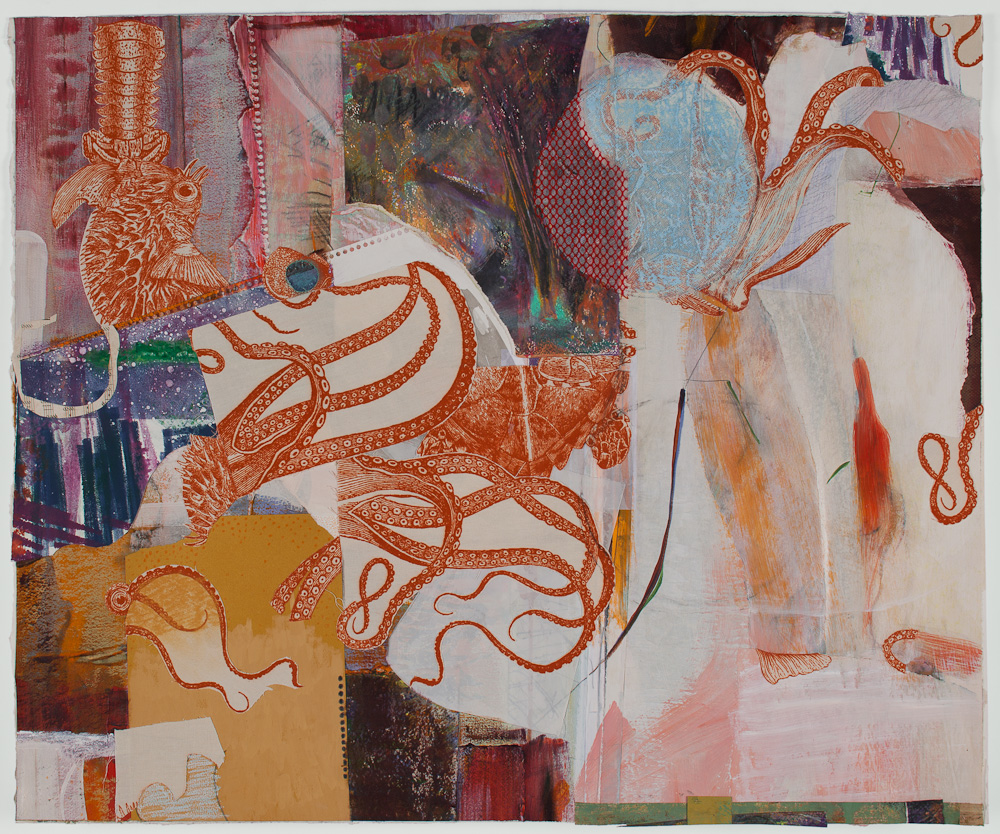
Judith has known my work for decades now and is a close reader. She asked me in particular about the piece below, asking if I'd read "Ocean of Earth" by Guillame Apollinaire, which I had not; I have added the text of this poem below the photo, and I won't attempt to comment upon it, except to say how remarkable it is: a wave carries along with it something that has been to sea, almost to shore, and back again, the way our ideas cycle through us and each other, across time and space - the marvel of eternal return. 

Ravenna Taylor, "Instrumental Dwellings 2," 2012, collage, 13.5 x 14 inches


"Ocean of Earth," Guillame Apollinaire

to G. de Chirico

I built a house in the middle of the ocean
Its windows are rivers which flow out of my eyes
Octopus stir all around its walls
Listen to the triple beat of their hearts and their beaks which
  tap on the window panes
                      Humid house
                      Burning house
                      Rapid season
                      Season which sings
         Airplanes drop eggs
         Watch out for the anchor
Watch out for the ink which they squirt
It's a good thing you came from the sky
The honeysuckle of the sky climbs up
The earthly octopus throb
And then we are closer and closer to being our own gravediggers
Pale octopus of chalky waves O Octopus with pale beaks
Around the house there is this ocean which you know
And which is never still


Translated from the French by Roger Shattuck
This translation was found online via Birds, Beasts, and Seas: Nature Poems from New Directions, by Jeffrey Yang.

Saturday, March 10, 2012

Acceptance Happens With The Head Held Up

Today, with a to-do list miles long, I began with my laundry. By the time I'd finished hanging it on the line, I had to run hot water over my fingers to thaw them. 


Even though my fingers were growing numb, I actually did take down a couple pieces and change them with others, because I enjoy the adjacent and occasionally dissonant harmonies of greens. How much would I leave to chance, how much tonal variation in the intervals? On a Saturday, and when time can allow, every action might be as a breath on a flame, and hanging laundry is not so unlike painting or singing.

I came in and warmed my fingers and sat down to read the chapter in The Poet's Freedom headed "Praising." Susan Stewart begins by discussing creation myths and human making, alluding to the Hebrew scripture, and the image of the supreme maker setting out on his task of creating the world, and calling each thing "good." She goes on to say
"The integrity of the thing is not a self-evident aspect of its form but rather a quality discerned at some aesthetic distance; completion is therefore determined, not simply reached as a point of arrival."

I enjoyed that observation, but became sidetracked by an undercurrent of thought I'd been having about human fallibility. A friend had mentioned that she'd seen an imperfection in one of her pieces. We talked a bit about imperfection, how I'd heard that medieval craftsmen had intentionally planned imperfection into their work, so not to appear to have the hubris to try to compete with their God.

But if there were a god to make us, and look on us and call us "good," then that god had to also be far from perfect, or at least to have imperfect judgment about the outcome of the work. Maybe this is how the creation myth came to assert that we humans were made in the image of god -- because of our shared imperfections? I'd never looked at it this way before, I can't remember how it was taught to me by the nuns who were my elementary school teachers.

I didn't get very far on my to-do list today. But when I was carrying out my laundry, I called the bluebirds, and instantly heard their twittering, and saw them swoop over to my house. Clearly these are same bluebirds I had last year and maybe the year before, since they know my call means I've brought them worms. I'm as near as they need me to be to perfection.


Friday, March 2, 2012

What A Drawing Is:


Last week, after visiting the exhibition at Matthew Marks Gallery in Chelsea, of Anne Truitt's drawings, I posed the question "What Is A Drawing?" and proceeded to explore it through images of my own "works on paper" (and fabric, and text). You can see that post just below this, with links to the gallery and Truitt's exhibition also (-- under the one that announces my online exhibition).

Today, as part of what I intend as an intermittent ventilation of my blog with the voices of others, I am posting photos of drawings by artist friends. I was delighted, as the photos came in, by the serendipitous alignments I found among them, all wonderful to my eye.

Each artist's drawing is below her or his name, and clicking on the name of the artist will open to a website for each. Click on individual photos for an even better view of each one. Enjoy ~ and my thanks to all the contributors!

 * * * * *


"Not paintings, not pure textile, simple with a lot of the ground plane showing...so a drawing."

"2012 #3," hand-dyed wool and egg tempera on linen, 14-1/2 x 12 inches


"I call the works done thusly WITHDRAWINGS... They are not really paintings even though I 'paint' a layer of gouache-tinted gesso on heavy watercolor paper; and they're not exactly drawings because the image isn't 'drawn,' but excised. I draw the image by cutting parallel lines with an exacto knife and revealing it by removing the gouache/gesso-fused uppermost layer of paperpulp between the cuts - leaving thin raw paper lines."
 

"Withdrawing"


charcoal drawing, collage, 2011


Untitled Dollar Drawing
ink on dollar, 2012


"A drawing is a riddle."

"riddle 01" - a paper 9 square quilt for dark nights.
conte crayon, graphite, on linen paper.


 Lori Ellison


"Well," ink on paper


"I've been drawing with fire, hot iron, hot glue, thread, and blades for years. I draw from the inside out. I get drawn in, I am drawn out. I draw out using any available tool in my surroundings. It is an additive/subtractive gesture and process of revealing/concealing. Stimulated by the universal element of fire, burning is a risky matter, holding both destruction and warmth. Drawing with fire leaves a mark I cannot erase."


Cosmic 2 ©UlaEinstein
a grid of fire drawings on rice paper, each 5" x5"


"Most of my work ends up more painting than not. For me drawing is mostly about line  but I get into a slippery slope once I start using words."

"Diagram A"


"These are blind contour drawings done with my right hand. I mostly paint now, but when I travel, I take book pages or use hotel stationery or whatever paper I can find and draw."


untitled contour drawings #1, 2009, ink on paper, 11 x 8 inches


"The snow drawings are done with my paint water for the day. I open the door to my studio and hurl it out in one or two gestures. Sometimes I think it is my best moment of the day. I often take photos of them. The light is always going down too."


"Snow Drawing 2," 2011


"I consider some of my works predominantly drawing even though I often 'draw' with a narrow brush and thin paint."

“Möbius Spin”, 2012, 14” x 5 ½”
Acrylic, metal pigment on cold pressed watercolor paper


Bascha Mon


"... it seems that it is just up to the artist to declare is this a drawing or not."


"This cameraless Chemigram uses photo paper, resist, and chemicals to degrade the paper's silver where not protected by resist, much like a print maker using a plate and acid bath; in the process, gesture and flow of chemicals and even resist are all part of the image. The photo paper is then processed as usual. I am drawing with the resist but the photo materials and flow of chemicals create images not possible with usual drawing materials. This piece uses an experimental resist I received when Golden Paint Co. invited me to demonstrate  use of their products in making Chemigrams. More information and images are at www.nsarachek.com."

Chemigram


"I did a series of these with Ilan Katin some years back. He did the ink lines, I did the colored pencil."

Patricia Fabricant and Ilan Katin
collaborative drawing, ink and colored pencil


"The subject of Drawing and what it means 'to Draw' seems to be in the collective conscious. It has gained momentum as a primary medium for quite some time. So what does it mean to draw? I would say it's like taking a line out for a dance. In my own work the boundaries are questioned and challenged through technique,materials and approach combining other mediums into the act. It's about 'the line'."

"the In-Between Spaces", 2011
3 dimensional drawing on light box, varied wires, pins, wax pencil, mylar

untitled drawing


ink on paper, 30 x 22"


".... anything with line? and i guess by that a lot of my works on paper come under that wide umbrella."

"History," 2011, oil, charcoal, pencil, 300gm watercolour paper, 37x27cms


"'Acanthus Climbing,' installation, is currently in a group show at the Kohler Arts Center called "The Line Unleashed." I have been working with these materials (pipe cleaners, yarn, fabric, plastic, thread, pins, and fishing weights) for over ten years and think of my installation work as drawing in space.


 Theresa Chong

 "Nini" (a porcupine/ in Native Alaskan Language), 2009
Color pencil and gouache on hand dyed Japanese Paper
32"x 46" 


* * * * *

In case anyone's wondering, the contributors self-selected by responding to the invitation I posted on my FB wall a number of times in the last week, inviting volunteers to respond to my earlier post on the blog, "What Is A Drawing?" No one who sent me a drawing was left out; it just happens they all look great together and cover a range of possibilities! I will be making other posts in the future, to bring my artist friends into the blog with their own voices or images, something I want to do at intervals, so my blog won't be such a mono-blogue!


Monday, February 27, 2012

Re: Vision

Ravenna Taylor, "Flamenco," 2012, painted collage, 28 x 33-3/4 inches


This piece is part of a series I call "Re: Vision." You can see 12 others - oil paintings on canvas, linen, and/or wood, and more painted collages - in my online exhibition; open the link here: Galerie Cerulean, at Abstract Art Online. Click on the image of the collage at the home page to open to the first of three pages, featuring four images on each page. Click on individual images for better views and titles, size, etc. Find the arrow key under the images at the right, to scroll to each of the next pages. I am pleased to share my new work, and with thanks to Joe Walentini.
This photo and those in the online exhibition, credit to Greg Benson and Fernando Gaglianese.


“Re:Vision”

Visual sensation stirs my attention to perception and thought; as emotion and thought impact senses and perceptions, my curiosity engages. My imagery derives from such observations, the dovetails and overlaps of lived experience. 

My paintings chronicle my choices; to choose is to begin, to be alive, to be human. Several of these pieces began as other works I’d thought were finished, but which I turned back into beginnings. I’m calling this assembly of work “re: Vision,” to disclose the revisiting, and refer to my preoccupations with our powers of perception and thought.

I compose my pictorial abstractions to excite associations. While nature’s phenomena inform the paintings, our human nature provides the long warp on which I weave. I have some favored subjects and allusions to arrange, like Morandi’s bottles. Among them figure time, games, measures, maps, fleet reflections and shadows. Artistic influences range widely, from Mughal miniatures to Modernism. I delight in color, harmony, patterns, and ambiguities. I construct and destroy, obscure and clarify; I celebrate choice.

February, 2012

Friday, February 24, 2012

What Is A Drawing?


Thursday of this week I went into Manhattan to visit a number of galleries in Chelsea. One of my first stops was at Matthew Marks Gallery to see a survey of "drawings" by Anne Truitt. If you follow the link, you will see the works, and perhaps understand why I questioned that designation. The person at the desk explained that Anne Truitt calls any work on paper a drawing, although the gallery press release does simply call them "works on paper," as I would do.


One wall at Matthew Marks Gallery installation of Anne Truitt's "drawings."

The other side of the gallery surveying Anne Truitt's work at Matthew Marks Gallery

I can remember a time when I would call any work on paper a drawing. The piece below, for example, was part of a series I made in 1997, growing from a fascination with Indian miniatures (which were being exhibited a lot at that time, for the 50th anniversary of independence). I called it a drawing then, but I would call it a painting now:

Ravenna Taylor, "Polyphony," 1997, watercolor and gouache, 22 x 20 inches

You can see more from that series, some of them I might call drawings, in the section of my website for "Work On Paper," here.

Now my thinking is that to be called a drawing, the work is not necessarily a dry medium, or one which exposes the paper, but one in which the paper is something more than a surface or substrate for the work. I still have some doubts about some of the work Anne Truitt calls drawings, because although the paper may be unprepared, and might be exposed at the edge, it doesn't contribute to the aesthetic or conceptual experience of the painted image; it is there for the acrylic paint, not for my eye.

Here are a couple drawings I made, on a beautiful handmade paper which is decidedly functioning as a part of the image and the viewer's experience:


Ravenna Taylor, "Susurrus 2," 2010, sumi ink, 11 x 14 inches

Ravenna Taylor, "Susurrus," 2010, sumi ink, 11 x 14 inches


I also do a lot of work in collage, using fragments of my own discarded work on paper, along with other materials, including photos I've taken and objects I find. Years ago I was more purist about them, but over the years I've used the collages as surfaces upon which to draw or paint; these I call "collaged drawings," or "painted collage," accordingly. The piece below I would call a collaged drawing. There a quite a few things in this category to be seen on my website.

Ravenna Taylor, "Parantrophic 1," 2000, watercolor and charcoal, 17 x 15 inches


Here is another, more recent collage (2011), which incorporates drawing, but I wouldn't call it a drawing; the piece also employs a photograph, stitching, fabric, an old postcard from the flea market, some monotyped paper from artist friend Pam Farrell - whatever I could find to make it work! This is one of those cases where one can only say "mixed media," as unhelpful as that is. (The photo fragment, incidentally, is of the surface of the sea from a water taxi in Venice: fond thoughts inserted here.) The lace fragments came from another artist friend, Francesca Pastine. The bit of red paper was another gift, from my friend, artist Nancy White.

Ravenna Taylor, "PM," 2011, collage/assemblage, 15 x 12 inches
(detail)


Below, a piece I made in 2010, one in a series of work on paper in watercolor and gouache, like the earlier series, this time using the history of game boards as a source for the imagery; you can see a dozen of these in my "Game Change" album, if you are a F.a.c.e.b.o.o.k user, HERE. I don't think of these as drawings, but as paintings, even though the paper is visible and figures strongly in the impact of the piece.


Ravenna Taylor, "Reward of Merit," 2010, watercolor, 11 x 11 inches


I once saw some text on a gallery wall, from a typewriter, framed and presented as a drawing; I was not persuaded. This is the statement I wrote in 2009 for my Game Change series, which employed shapes derived from study of hourglasses and a preoccupation with time. I composed the text of my statement in the form of a concrete poem, so each stanza would ebb and flow like time, like the shape of an hourglass. Yet I would not call this a drawing. The first quality of a drawing, in my mind, has to involve a hand. If I'd written the poem/statement out on paper, in this form, that might stand on the threshold of a drawing, to my way of thinking; but I still wouldn't call it a drawing.

2009 Statement written to give each stanza a shape like an hourglass

And these pieces in embroidery thread on fabric, of which I made about 10 back in the 1990's -- I would argue that these are more like drawings than some of the work on paper I have made, and more than some of the work on paper in the Matthew Marks gallery, which are being presented as drawings. The exhibition is, as always is the case with Matthew Marks Gallery, perfectly installed, and Anne Truitt's pieces are perfectly beautiful, whatever they might be called. The show remains on view into April.

I might carry on with this unfolding thought about what a drawing is in my next post, with work by other artists. It's not that it matters at all; but since we can suppose that the activity of drawing might be the earliest form of artistic expression in our history as a species, it's interesting, to me, to think about what is a drawing.


Ravenna Taylor, Embroidery, 199?, thread, fabric, about 6 x 7 inches

Ravenna Taylor, Embroidery, 199?, thread, fabric, about 7 inches square


More "painted collages" are included, along with 7 new oil paintings, in my online-only exhibition, "Re:Vision," commencing February 27, 2012, at Galerie Cerulean Currently, the Galerie website has an archive of my show of last year, "Song Cycle," a series of photo collages.

Saturday, February 18, 2012

Instrumental Dwellings

"Limbo," 2012, oil on panel, 6 x 4 inches

I'll begin with a denial -- I'm not a slow reader; but I can be distracted and slow to settle into my reading. I'm doing too many things at once, and as a friend observed today, I invest myself entirely in whatever is currently at hand, whether my music, art, writing, or just being with a friend, attending to another's need. So I don't actually read slowly, but intermittently, and ambitiously; I frequently find myself, when sitting down to read, going back to reread what I finished in my last sitting. I'm like a wide slow stream with eddies, bends and loops; or maybe like Penelope, weaving, unweaving, beginning again to weave.

I'm taking this kind of long time with a book I found last month. Here's a photo of its beautiful cover, the image is by Ann Hamilton. The book is "The Poet's Freedom: A Notebook On Making," by Susan Stewart, poet and professor at Princeton University. The book was published by The University of Chicago Press, 2011. The cover and title caught my eye in the bookstore, and the chapter headings stirred my interest.


I am still in the first chapter, headed Beginning - (I wryly confess I am beginning it over and over). Coincidentally, as I was opening the book, I was also writing my new statement for the work that will soon be exhibited online and in my studio. I'm titling my show "re:Vision," also the title of a blog post in January when I was formulating these thoughts. Here's the text of my statement, which doesn't describe the objects I've made, but my objectives in making them - (these have become rather consistent, however much their expression changes):

 * * * * *

Visual sensation stirs my attention to perception and thought; as emotion and thought impact senses and perceptions, my curiosity engages. My imagery derives from such observations, the dovetails and overlaps of lived experience.

My paintings chronicle my choices; to choose is to begin, to be alive, to be human. Several of these pieces began as other works I’d thought were finished, but which I turned back into beginnings. I’m calling this assembly of work “re: Vision,” to disclose the revisiting, and refer to my preoccupations with our powers of perception and thought.

I compose my pictorial abstractions to excite associations. While nature’s phenomena inform the paintings, our human nature provides the long warp on which I weave. I have some favored subjects and allusions to arrange, like Morandi’s bottles. Among them figure time, games, measures, maps, reflections and shadows. Artistic influences range widely, from Mughal miniatures to Modernism. I delight in color, harmony, patterns, and ambiguities. I construct and destroy, obscure and clarify; I celebrate choice, and our humanity.

February, 2012

* * * * *

My inner ear perked up today with my reading, as I came to the following passage, in which Stewart is quoting Aristotle in his Nichomachean Ethics:

"All art is concerned with the realm of coming-to-be, i.e., with contriving and studying how something that is capable both of being and not being may come into existence, a thing whose starting point or source is in the producer and not in the thing produced." 

That last, about the starting point, speaks also to the reason that I feel that I am a painter first and everything else I do falls into place behind that. In painting, the effort isn't only to execute the work with skill and expression, but to initiate the concept and determine the content. As Stewart says earlier in the chapter (p.12),

"It is difficult, certainly, to argue for making more things. If we have an environmentalist's conscience, restraint and even withdrawal seem the most moral responses to the natural world. At the same time, we constantly feel the pressure of the need to make new art... Indeed, every generation seems to have an obligation to the future not only to represent its thinking in created forms but also to use created forms as a means of thought itself. The necessity of starting out, of new beginnings, is as central to our existence as life itself - the very nature of our vitality."

I am privileged by this drive to compose. My chronicle is my exercise of choice. To choose, to begin, is to be alive, and human. 


Susan Stewart chose this poem by Emily Dickinson as the epigraph for her beautifully composed and realized book, which I've just begun, and begun again, several times. The next chapter is headed Praising.


Thursday, February 9, 2012

PRETEND

I've been pressing forth with new work in the studio, and I'm excited by what has been unfolding. The work was photographed yesterday, and today I labored over my 150 word statement to present with the work. I have seven paintings and five collages which I look forward to displaying in the online-only gallery, Galerie Cerulean, at Abstract Art Online, beginning February 27, 2012. The Galerie is a project conceived by Joe Walentini, who is also an abstract painter; he began his website writing reviews of gallery shows in New York in the 1990's. A few years ago he changed his mission to showing the work of a selection of artists, keeping a schedule like any other gallery, but always online-only. He was a pioneer; now there are many more online venues for artists, and people are more accustomed to viewing work this way. The internet has opened up minds and entire worlds for artists, especially for those of us who are unrepresented and/or located a little off the beaten track. As I like to say, a deadline can be a lifeline.

My studio in Lambertville, New Jersey is in an old stone building, and the back room in which I work has (other than skylights and a back door) only one narrow window, where I sometimes stand to rest my eyes on something more distant than my work. There are trees and buildings, and my line of sight is pretty narrow, landing on a sign that reads "DEAD END." The sign is old, bent, and a bit of graffiti has been attempted on its fading paint. It is set rather high, maybe to be at the eye level of truck drivers. Otherwise I might have gone out there to deface it myself! I often looked at those words, "DEAD END," and imagined how I could transform them into a more uplifting image for my fatigued vision.


The intersection is on my walk to the cafe or the natural foods store, and I imagined myself dressed as a public works employee, dragging a ladder over with a small can of black paint, to carefully change the text so that maybe no one would even notice that instead of DEAD END it might read:


PRET
END


Here is a small painting I recently completed which I will not be exhibiting with the others:


PRETEND, 2012, oil on canvas, 4 x 6 inches


Well instead of carrying out this plot, I made my small painting, a sunny diamond in an elliptical sky. Or maybe this is just a sketch for my future career as street vandal? Nah. I am ever grateful for the opportunity to picture my world, and change it in my imagination, or by making with my hands a new image of what seemed immutable.